By Daniel Pearson
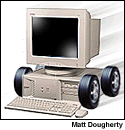 It's likely most people who have entertained the idea of telecommuting picture themselves perched in front of their home PC, fresh coffee gurgling in the kitchen, no boss breathing down their neck or coworkers interrupting inspiration with idle chit-chat, and maybe even hearing their children playing in the other room.
While teleworking does provide a certain amount of freedom, it doesn't mean workers can wake up at noon, lounge around until 1:30 p.m. or so, and then get to work. On the contrary, it takes a lot of discipline and the ability to turn in excellent work without coworkers in the next cubicle to bounce ideas off of.
Telecommuting is an idea whose time has come for the nonprofit sector, many say. It not only benefits workers, it also makes sense, financially and logistically, for some employers.
 A 1999 study by the International Telework Association and Council (ITAC) finds that 19.6 million people worked from home nine days per month -- saving employers 63 percent on the cost of absenteeism per telecommuting employee, and more than $7,000 per position by not having to replace workers who might leave because they were unsatisfied with their jobs.
"Telework is increasingly being recognized not as a luxury but as a necessary component of the evolving structure of modern work patterns essential for helping employees better balance work and home life," said Joanne Pratt, the survey's director.
But the feasibility of the virtual office is rarely discussed in nonprofit circles and data on telecommuting's role in the philanthropic world is preliminary at best.
Nonprofit Telecommuters
Phil Bailey is the executive director for Earth Systems Inc., a Charlottesville, Va.-based nonprofit that provides environmental education and information resources. Bailey has been telecommuting for the last six years and finds it more efficient than traveling to the office every day.
"The first thing I noticed was I could accomplish more working at home without the almost constant interruptions of a busy office," he said. "It has allowed me the flexibility and freedom to do my job to the best of my ability."
Bailey's daily responsibilities include overseeing all of Earth Systems' operations, including managing its Web site -- which contains more than 1,200 environmental Web site members and their links -- reviewing several publications the company produces (including electronic newsletters, mailing lists and eco-travelogues), and all of the organization's fundraising. And he never misses a beat.
"Plus, I'm far more involved and available to my kids," Bailey said. "I've always made it a point to be home (between) 5:30-6 p.m. Now, I'm home when they return from school."
Dedication to family life is a big factor for telecommuters in their choice to work from home. The ITAC finds 72 percent of teleworkers with children said they had to take time off for school-related functions before they began working from home, and 44 percent had to take time off because their child was ill. Likewise, 49 percent of telecommuters said they have had to use personal or sick days to tend to basic needs, such as going to the bank or having a car serviced.
Almost one-third of telecommuters said they still manage to squeeze in two to four hours of work after tending to these needs, which equates to about $1,227 of money saved by employers per employee per year, the ITAC finds.
"One does save a great deal of time," Bailey said. "(If you also) take into account the time and energy involved in commuting, being sociable in the office, meetings...I've estimated that I save 4-5 hours per day by telecommuting."
That can translate into big bucks saved by employers. But time isn't the only asset an organization will recover by allowing employees to telecommute. Some nonprofits may have never developed if they had to rent office space during their early stages.
Gary White is executive director of WaterPartners International, dedicated to providing safe and adequate drinking water supplies in developing nations. WaterPartners, based solely on the Internet, is truly a virtual company.
White helped found the organization in 1993 while attending the University of North Carolina at Chapel Hill with a volunteer staff of other graduate students. The Internet was just beginning to show its potential then, so when the staff graduated from UNC at roughly the same time and began accepting jobs in different cities around the country, WaterPartners used the emerging medium to its advantage.
"E-commuting allowed us to continue to draw on the skills of people no matter where they moved," White said. "Since we could not pay salaries in the early days, we had to rely on people to work with us who had other full-time jobs. Obviously, if we had constrained our pool of workers to one geographic area, we would have problems attracting highly-skilled people who also had time to donate."
WaterPartners currently has three full-time staff members in Seattle, Columbia, Mo. and Carrboro, N.C., and five other workers in three other cities. White said they rely heavily on the Internet and phone calls to keep the organization running smoothly, but primarily work through e-mail and ftp file transfers.
"E-commuting also drastically cut salary costs for us and this allowed us to contribute a large portion of our budget to program expenses," he said. "The bottom line is that many more people in the developing world now have access to safe water because WaterPartners fully embraced e-commuting."
Employers have to keep in mind that embracing telecommuting doesn't mean OHSA standards or employee benefit packages can be ignored. They also have to ask themselves the question: What skills do I need to look for in a telecommuter? Part two of this series will explore these issues.
Daniel Pearson can be reached at
danielperson@mindspring.com





























 Telecommuting --




