By Daniel Pearson
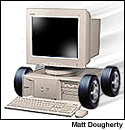 It is widely believed that most telecommuters need nothing more than a computer, phone line, paper and writing implements to get started, which -- if true -- would be great news for nonprofits.
However, there are several questions about e-commuting an organization should consider before an employee walks out the door with a computer under his or her arm.
"It seems that most anyone we have hired or would hire as a telecommuter would already have (the equipment) needed to telecommute," said Gary Davis, executive director of the "virtual" nonprofit WaterPartners International. "With end user technology requiring less and less in terms of technical abilities, candidates for telecommuting are everywhere."
Once an organization identifies good candidates for telecommuting positions, managers need to think about technology issues and limitations. Davis mentioned previously that most of his employees at WaterPartners rely heavily on e-mail and electronic file transferring to keep the organization afloat in the digital sea. But as the company grew and its efforts began expanding to regions across the globe, it created a need to expand its Web site to provide more support services and information to its staff and board of directors.
Most telecommuters, like those at WaterPartners, only need occasional LAN or server access (in most cases, employees are downloading or uploading files, or fulfilling Web site update responsibilities). Those employers who monitor workers' computer usage will find these patterns easy to determine and will be able to keep their systems from being overwhelmed. But there are other security issues to ponder, such as who will be allowed access to company data over the Internet, since information transferred on the Web can be intercepted by a third party
One way to balance remote access with security is to establish a virtual private network (VPN), which will also boost security for office-to-office connections. VPNs work this way: software installed on employee PCs allows telecommuters to connect to a company intranet server. Both ends are encrypted to keep file transfers safe, and everyone has to use an approved password to log-on.
Although installing a VPN can require a huge initial effort, it may save money in the long run through savings on such items as long-distance phone bills, because telecommuters can access a local Internet service provider from wherever they may be. VPNs can be created by an organization's own employees, or can be purchased and/or installed by third-party vendors. This decision often depends on an organization's budget and the technological capabilities of its staff.
Equipping home offices
A study completed by Telecommute America finds that "teleworking" employees say proper management is a key issue for them. One of the best ways to help is to make sure an employee's home office is designed for both efficiency and comfort.
Candice Woodward, a professional ergonomist, told SmallOffice.com that employers should visit their workers' homes to learn the unique qualities of their environment, including how the telecommuter spends most of his or her time, what existing furniture the employee already owns that can be used to improve the environment, and the size of the home office space.
Woodward recommended working with an ergonomics expert to better understand potential problems, and making sure the employee has a comfortable chair with often-used objects within arm's reach.
There are a number of resources available on the Internet for employers considering opening their organization to telecommuting. One of the best is found at About.com, which is managed by a telecommuter. It contains information on just about every topic related to e-commuting, links to more resources, and discussion groups.
Another solid telecommuting site is Gil Gordon Associates. This site has been operating since 1995 an has information from sources around the world that are involved in telecommuting.
A diverse page of resources can be found at the San Gabriel Group's Web site. Employers will find links here to electronic newsletters covering the latest trends in telecommuting, professional telecommuting organizations and handbooks on everything from getting a program off the ground to keeping it running efficiently.
For further information on setting up a telecommuting program, visit AT&T;'s Environment, Health and Safety website. This is a thorough source for considering the environmental effects and the bottom line for employers.
Implementing a telework program may require some research and a lot of planning for nonprofits who are still coming of age in the new cyberculture, but the long-term benefits are numerous. Besides allowing employees flexibility, and a little breathing room, telecommuting can expand a nonprofit's outreach and possibly bring in new sources of funding. This topic will be explored in the fifth and final installment of the series.
Daniel Pearson can be reached at
danielpearson@mindspring.com





























 Telecommuting: Considering the tech question




