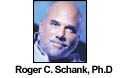
 Even as teachers try to integrate digital technology into their curriculums, the entire educational process will be revamped to better reflect the most efficient, effective ways people learn. Taken to its most extreme, this means teachers might be replaced by software packages so advanced that students in even the poorest districts will have access to the highest-quality education, according to a New York Times profile of Roger C. Schank, Ph.D.
This new software goes far beyond simply taking classroom lectures, converting them to text, adding graphics, then handing it over to students. The next generation of computer-based learning systems uses video, real-world scenarios, scripted news broadcasts, and simulated challenges that range from building, launching and landing a Mars probe to identifying and then stopping a worldwide viral outbreak.
 Schank is the man behind what might be a revolution in the learning process as a whole. He's director of Northwestern University's Institute for the Learning Sciences (ILS) and founder of the for-profit Cognitive Arts software firm. In his role at ILS, he's grown to strongly believe the education field is ripe for revolt.
"We have a whole country of people who agree on education, and they're all wrong," he told the Times "School just isn't that relevant anymore. We'll make it relevant. We're trying to overthrow the system."
The systems he first developed at ILS and now sells through Cognitive Arts for commercial groups are based on extensively detailed problem-solving scenarios. The packages can cost $1 million to produce and take a year to put together, the Times reports.
As students work their way through the scenarios, they access detailed archives related to the field they're studying -- biology, physics, political science, for example -- and can review interviews with experts in the field. As they progress in the scenario, they experience what Schank calls "just in time" learning, as opposed to having dry facts and figures told to them.
"Software is going to replace classes as we know them...," he says. "The computer is our Trojan mouse. It allows us to get our foot in the door to do something radical and difficult."
His remarks -- and his complete confidence in the view that the educational system as we now know it is outdated and inefficient -- has enraged academicians around the country.
And while it's far to early to tell if Schank is correct, he's confident new technology will prove him right.
"The value of the computer is that it allows kids to learn by doing," he told the newspaper. "People don't learn by being talked at. They learn when they attempt to do something and fail. Learning happens when they try to figure out why."
Free registration may be required to view this article:
http://www.nytimes.com/library/tech/yr/
mo/circuits/articles/10prof.html